

The cicadas are coming, but for some, the noise never stops
Nearly five million Americans have pulsatile tinnitus, a sound in one or both ears that synchronizes with their heartbeat and can be debilitating

CHICAGO – May 22, 2024 – As cicadas emerge across the United States, the harmless insects are bringing their traditional “sounds of summer” with loud, high-pitched noises that sound like a buzz, shrill or shriek. Cicadas have a lifespan of approximately four weeks, so while their noises are short-lived, another sound continues for millions of Americans long after summer has ended.
Tinnitus is a buzzing, ringing, hissing, whistling or clicking sound in one or both ears, which occurs in the absence of external noise for nearly 20 million Americans. Some people refer to tinnitus as sounding like “cicadas in their heads.” Five million Americans with tinnitus have pulsatile tinnitus, a rhythmic pulsing noise in one or both ears that tends to synchronize with their heartbeat. The noise is often described as a “whooshing” sound heard when the heart beats. The Northwestern Medicine Pulsatile Tinnitus Clinic is one of a few clinics in the U.S. dedicated to evaluating and treating patients with pulsatile tinnitus.
“While cicadas bring loud noises for a short period of time, it’s nothing compared to what patients with pulsatile tinnitus are hearing every single day. Some describe it as a ‘whooshing’ sound or very similar to a baby’s heartbeat on an ultrasound machine pulsating through their ears,” said Ali Shaibani, MD, interventional neuroradiologist at Northwestern Medicine who sees patients in the Pulsatile Tinnitus Clinic. “For many patients, the noise interferes with everyday life and can be debilitating. I’ve had patients come to me with suicidal thoughts or even compressed their own jugular vein to try and make the noise stop.”

Patient Story
In October 2022, Dana Pulciani woke up with a horrible “heartbeat noise” or “whooshing noise” in her left ear. If she wanted to hear people talk, she’d have to push on her jugular vein. Pulciani had been a medical assistant for 20 years before moving into an administration role at a pain management clinic, so she knew something was wrong.
The then 38-year-old scheduled an appointment with Alexander Schneider, MD, an ear, nose and throat (ENT) specialist at Northwestern Medicine, who immediately thought she might have pulsatile tinnitus, telling her he had only seen a handful of cases in his career. Dr. Schneider ordered an MRI, which showed a narrowing of the artery next to a small aneurysm in her brain.
Meanwhile, Pulciani started taking yoga classes to try and train her brain to ignore the “whooshing” noise. She also joined a Facebook group called the “Whooshers” and one of the group members recommended Dr. Shaibani. That same week, Dr. Schneider was able to get Pulciani an appointment with Dr. Shaibani.
In November 2023, Pulciani underwent minimally invasive surgery with Dr. Shaibani who placed one stent in her artery and another in the aneurysm. Immediately after waking up from surgery, the “whooshing” noise was gone.
Pulciani is back to living a normal life and can’t thank Drs. Schneider and Shaibani enough for their care.
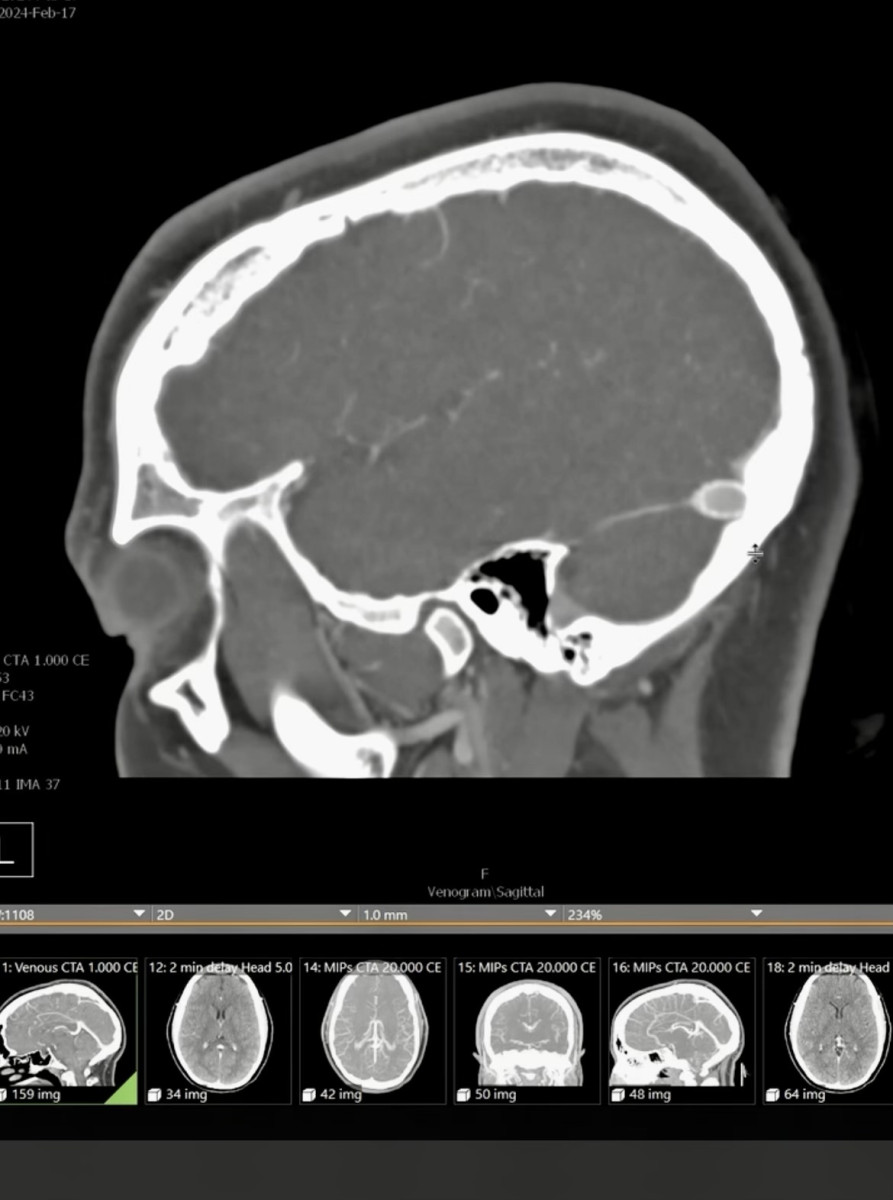
Causes of Pulsatile Tinnitus
Pulsatile tinnitus occurs due to issues with blood vessels in the head and neck. Conditions range from harmless to dangerous. The causes of pulsatile tinnitus are diagnosed through a series of hearing, physical examination and imaging tests to show what’s happening inside the patient’s skull.
One of the most common causes of pulsatile tinnitus is idiopathic intracranial hypertension (IIHTN), where the pressure inside the head is elevated. Many patients with this condition have a narrowing involving the two main veins that relieve the pressure in the head, by taking blood and cerebrospinal fluid back to the heart.
“When the two large veins that bring blood out of the brain are narrowed, it can cause the ‘whooshing’ sound. It’s similar to how a whistle works – it pushes air through a narrowed space. In most cases, this can be treated with medication, but in severe cases where the patient’s vision is threatened or the medications aren’t adequate, we must open up the vein through minimally invasive endovascular surgery to reduce the pressure and relieve the tinnitus,” said Dr. Shaibani.
Aside from hearing the “whooshing” noise, the most common symptoms associated with IIHTN include daily headaches and vision issues. Symptoms can increase or decrease when a patient lies down or turns their head. Symptoms can also change when pressure is placed on the jugular vein. Pulsatile tinnitus can often be cured once the underlying cause is treated.
A less common but potentially more dangerous cause of pulsatile tinnitus is the development of a short circuit connecting arteries directly to veins (arteriovenous shunt) close to the base of the skull. The battery of tests ordered by the Pulsatile Tinnitus Clinic staff is designed to also look for this cause. Fortunately, this condition is also treatable in the vast majority of cases using minimally invasive endovascular techniques.
Treatment Options
- Medication used to tread underlying conditions such as hyperthyroidism, anemia, elevated intracranial hypertension or high blood pressure.
- Endovascular minimally invasive surgery such as stenting, can correct certain underlying conditions, including an aneurysm.
- Self-management techniques may help ease symptoms if there’s no underlying cause. These may include sound therapy, cognitive behavioral therapy and tinnitus retraining therapy.
Very few clinics in the U.S. have a multidisciplinary team of pulsatile tinnitus specialists. The Northwestern Medicine Pulsatile Tinnitus Clinic is made up of experts in many fields, including neurointerventional surgery, otolaryngology (ear, nose and throat), neurology and neuroradiology.
To schedule an appointment, call 312-926-3185 or visit nm.org for more information.









Contact

Add me on LinkedIn (opens in new window)
|
Jenny Nowatzke Program Director, Media Relations Northwestern Memorial Hospital Pulmonology and Lung Surgery, Cancer, Infectious Diseases |